



Podcast: Play in new window | Download
 Paula Goldman has been thinking about the role AI should play in our workplaces long before the current boom. As Salesforce’s first Chief Ethical and Humane Use Officer, she has spent years helping one of the world’s largest technology companies determine how powerful technologies can be developed and deployed in ways that earn trust and serve people.
Her work has included building ethical frameworks, establishing safeguards, engaging employees and stakeholders, and helping make ethical decision-making part of how technology gets built—not something added after the fact. Goldman argues that ethics is not a checklist; it is a mindset and a culture in which people throughout an organization take responsibility for the consequences of what they create.
Now, as AI moves rapidly toward autonomous agents capable of taking action, Goldman is focused on a bigger question: How do we make AI work for people rather than simply make people work differently for AI?
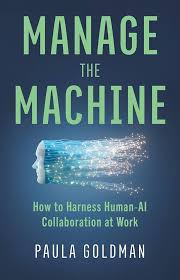 Her new book, Manage the Machine: How to Harness Human-AI Collaboration at Work, explores that question. Rather than viewing the future as a contest between humans and machines, Goldman envisions a workplace that is “human elevated”—one in which AI takes on more of what machines do well while people contribute more of what makes human judgment valuable.
That requires leaders to rethink jobs rather than simply automate existing tasks. It means deciding where AI belongs, where human judgment must remain central, and how employees can develop the skills to work effectively with increasingly capable machines. Goldman has argued that the old idea of keeping a “human in the loop” is no longer sufficient as AI becomes more autonomous. The better model is “human at the helm”: people remain accountable for determining how AI is used, interpreting its output and making consequential decisions.
The conversation also explores what happens when technology begins to resemble a colleague, why humans so readily attribute intelligence and agency to machines, and what leaders need to understand about creativity, discernment and common sense that cannot simply be automated.
Most importantly, Goldman challenges leaders to look beyond the immediate promise of productivity. If AI is going to transform work, the critical investment is not only in the technology. It is in people—their skills, AI fluency, judgment and ability to know when a machine should be trusted and when it should not.
For leaders trying to navigate AI without losing sight of the people who make their organizations work, Goldman offers a compelling argument: the future of work should not be about replacing human beings with machines, but about using AI to elevate what people are uniquely capable of doing.
