


Podcast: Play in new window | Download
 As leaders, we often believe our greatest limitations come from a gap in our skills, knowledge or experience. Pam Manfredo Curtis argues that something we may never have considered likely has even greater influence than any of these.
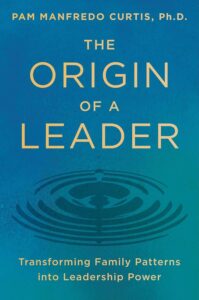
In her work as an executive coach and author of The Origin of a Leader: Transforming Family Patterns Into Leadership Power, she holds that roughly 80 percent of how we act, think and present ourselves in the world was shaped in our childhood – by our parents, siblings, people closest to us, and the significant events we experienced. The point is most of us carry those influences into our work without knowing it – and without ever having reflected on whether the beliefs, behavior and strategies we cultivated during our childhood continue to serve us well today.
Coincidentally, these ideas are the foundation for “Know Thyself” and “Know Thy Values,” the first two chapters of Mark’s book, The Power of Employee Well-Being. When leaders actively explore all of the influences that shaped them and come to deeply understand how their values and behaviors were formed, they gain the freedom to act in ways they intentionally choose instead of in ways they were influenced to act long ago.
 In this conversation, Pam explains what it means to dive into a leader’s backstory and how to identify the “supporting cast” of childhood figures who may still be driving management decisions and interpersonal habits today.
She describes three kinds of upbringing she sees in her clients (they grew up in homes of stability, complexity and/or trauma) and what happens to a team’s psychological safety and well-being when someone unknowingly leads from the emotional age of an unresolved trauma. We also discuss why “inner child” work became a mocked pop-psychology meme, and how she reaches skeptical executives who instinctively resist it.
The conversation goes back to the beginning: what convinced Pam, both personally and professionally, that childhood shapes leadership so profoundly that she built a career and a book around it. It moves through real examples of the behaviors she’s seen show up in the executives she’s coached — patterns that trace directly back to how they were raised — and what it actually takes to notice and change them. The lens turns inward on both sides of the mic, with real pieces of upbringing on the table, not just theory.
This is really a deep-dive into self-work that is at the core of becoming a self-aware and highly effective leader, and intentionally gets into the practical questions that matter most: how long does this kind of self-examination realistically take, what percentage of leaders have actually done it, and what happens to the people around a leader — their teams, their families — when they finally do. It doesn’t shy away from the harder edges either, including what this work looks like for someone whose childhood was genuinely painful, and whether it’s something you can do alone or whether it requires another person to see what you can’t see in yourself.
It’s a powerful conversation in support of your own self-exploration.
